Loading health centre …
 VårdbetygVårdbetyg
Gotland · Gotland
Vårdcentralen Slite has a Vårdbetyg of 79.8 out of 100 (a high score), based on 82 responses in the National Patient Survey 2025. That is 1.7 points below the national average (81.5), and rank 4 of 6 rated health centres in Gotland. 98% of patients get a medical assessment within 3 days (July 2026).
The Vårdbetyg is not a raw average of the responses. Few responses are pulled toward the national average, so a high average on thin evidence cannot top the ranking by chance. How we calculate it
Updated with the National Patient Survey 2025 · Waiting times: July 2026
Vårdbetyg
1.7 below the national average (81.5)
Based on 82 responses
Combined from patient experience (74.2, from the patient survey) and accessibility (92.9, from waiting times), adjusted toward the national average. How we calculate it.
Two parts, each first shrunk toward the national average by how many answered, then weighted:
Combined rating 79.8
Patient experience builds on the unit’s own answers about 73 %; the rest is drawn toward the national average for patient experience (78.2) because 82 patients answered. Fewer answers means a stronger pull, so a thin basis can’t top the ranking on chance.
The Vårdbetyg is a combined score, not just a survey number: patient experience (the National Patient Survey 2025) counts for 70% and accessibility (waiting times from the National Board of Health and Welfare) for 30%. Here you also find what a survey does not show: contact details, opening hours and e-services. How the score is calculated.
What the symbols mean:
The wider the line around the dot, the less certain the figure, usually because fewer people responded. Read more in the methodology.
Municipality 77.8 · Region 77.8
Municipality 82.6 · Region 82.6
Municipality 78.6 · Region 78.6
Municipality 73.2 · Region 73.2
Municipality 65.3 · Region 65.3
Municipality 81.3 · Region 81.3
Each dimension is built from several survey questions. Here are the individual questions and how patients answered. This is added depth; none of it counts toward the Vårdbetyg.
How did you experience the care you received during the visit?
81 answers to this question
How much trust did you have in the doctor?
82 answers to this question
Did you feel that the doctor took you and your health problems seriously?
82 answers to this question
What was your experience of how the doctor treated you?
82 answers to this question
How did you feel that the doctor listened to you?
82 answers to this question
How did you experience the opportunity to be involved in your care?
81 answers to this question
What is your experience of being able to ask questions?
80 answers to this question
How did you experience the opportunity for relatives to be involved in your care as much as you wanted?
81 answers to this question
Did you receive information that suited you?
81 answers to this question
What did you think about the information regarding the next steps?
77 answers to this question
How well informed did you feel the doctor was about your medical history and previous care?
82 answers to this question
How did you experience the opportunity to see a doctor you had seen before?
79 answers to this question
How did you experience that the coordination with other care and services worked?
80 answers to this question
How did you experience the waiting time until you could visit the health/medical center?
81 answers to this question
How do you think it works to get in touch with the health/medical center?
80 answers to this question
The figure is the same 0–100 scale as the dimensions above, per question. The triangle marks the national average. The distribution includes the Not applicable / Don’t know answer, so the bars add up to 100 %. No per-question figure affects the Vårdbetyg.
Share of patients reached in time and how long they had to wait, from the primary-care waiting-time statistics of the National Board of Health and Welfare. The median is the midpoint, half waited less and half longer. This is the accessibility part of the Vårdbetyg, separate from the Accessibility dimension in the patient survey above.
The statistics are preliminary. Accessibility counts for 30 % of the Vårdbetyg (patient experience 70 %). Only the shares for assessment within 3 days and answered calls enter the score; the other rows are context and never affect the score.
Source: National Board of Health and Welfare, primary care waiting times. Open data at the statistics database.
Three questions many people ask when choosing, answered with the same open figures shown on this page. No new measures, no new score.
Continuity in the patient survey: 56.6 – below the national average (70.5) · 78 responses
The share with a named regular doctor is not available as open data for this region.
Medical assessment within 3 days: 98% (July 2026)
Answered calls: 88% (July 2026)
Averages for the whole unit (preliminary statistics), not your personal wait.
Involvement: 77.2 – below the national average (80.4)
Information: 70.4 – below the national average (74.9)
These are patterns in open data, not judgements about staff or intentions. Differences from the national average can have many explanations, and the figures say nothing about why they look the way they do. What we cannot measure is listed under What we can’t measure.
The results held steady 2015–2024.
From the National Patient Survey. The survey was redesigned in 2025 with new questions and response scales, so the 2025 value is a new starting point and is not compared with earlier years. The curve therefore breaks at the change and 2025 is shown separately. The trend above covers Primärvård (2015-2024). Years without a survey are left blank, we never guess. Small ups and downs that could just as well reflect who happened to respond count as unchanged, not as a change.
Where the municipality has at least 3 primary care units with comparable measurements, the municipal average is shown as a dashed reference line. The average is calculated on the same units throughout the series.
The municipal average in Gotland is unchanged 2015–2024 (average of 5 primary care units).
The municipal average in Gotland rose 2015–2024 (average of 5 primary care units).
The municipal average in Gotland is unchanged 2015–2024 (average of 5 primary care units).
The municipal average in Gotland rose 2015–2024 (average of 5 primary care units).
The municipal average in Gotland is unchanged 2015–2024 (average of 5 primary care units).
Not measured in the 2025 survey.
Not measured in the 2025 survey.
How many responses the Vårdbetyg is built on. More responses give a more reliable result.
Independence: no care provider pays for placement or scores on Vårdbetyg, and we carry no sponsorship and no booking commission. The scores are calculated solely from open, year-stamped sources – the National Patient Survey 2025 and the National Board of Health and Welfare’s waiting-time statistics – never from submitted reviews. How we stay independent.
Below are facts and context. None of it counts toward the Vårdbetyg.
Facts about the health centre.
Source: 1177 Hitta vård (the HSA catalogue).
Contact details and opening hours from 1177. Not part of the Vårdbetyg score.
Register with Vårdcentralen Slite (1177.se)
Source: 1177 Hitta vård (the HSA catalogue), retrieved 18 August 2026. Details may change – check 1177.se.
The health centre's address and location.
Vårdcentralen Slite scores 79.8 out of 100, slightly below the national average of 81.5, based on 82 survey responses (a 55% response rate, so results carry some uncertainty). Patients rate accessibility highly overall (92.9), supported by strong waiting-time figures: 98% got a medical assessment within 3 days and 88% had calls answered at first contact. However, within the survey dimensions, continuity stands out as notably weak at 56.6, well below the national average of 70.5, while respect and empathy is the relatively strongest dimension at 82.5, though still slightly under the national figure.
Automatically generated summary, grounded in the figures on this page (the patient survey 2025).
Share of the region’s primary-care diabetes patients reaching the target value, from the Swedish National Diabetes Register (2024). The row on high blood-sugar level is the exception and instead shows the share above 70 mmol/mol.
This is regional context, not this health centre’s own figures.
Source: the Swedish National Diabetes Register via Vården i siffror.
Antibiotic prescriptions per 1,000 inhabitants in the region’s outpatient care. Strama’s target is at most 250 prescriptions per 1,000 inhabitants per year (2025).
This is regional context, not this health centre’s own figures. Lower is better.
Source: the Public Health Agency of Sweden, antibiotics statistics.
Vårdbetyg is built only on open, year-stamped sources. Some of what patients care about most is not in any open data per health centre. When that is the case we say so plainly instead of guessing.
A missing figure like this does not mean anything is wrong with this particular health centre, only that it can’t be measured fairly in open data. We never put a number or a judgement on something we can’t substantiate, and never single out an individual clinic on a guess.
Have a concern about a specific health centre? Your region’s patient advisory committee (patientnämnden) receives it free of charge, and serious deficiencies can be reported to IVO.
Which of these would you most like to know?
We only count how many press each option. The answer is about the question, not about this health centre.
The Vårdbetyg above is built on patient ratings from the National Patient Survey, a systematic survey that outweighs individual reviews. Fresh Google reviews appear as a standalone complement when available.
Proud of your rating? Copy the code and show the Vårdbetyg on your own website. The badge updates automatically when new data arrives and links back here. No cookie, no tracking.
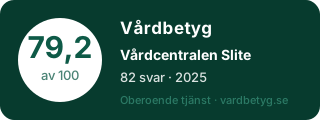 This is how the badge looks.
Vårdcentralen Slite has a Vårdbetyg score of 79.8 out of 100, which is a high score. The Vårdbetyg is a combined measure of how patients experience the health centre and how accessible it is, based on the National Patient Survey 2025 and the National Board of Health and Welfare's waiting-time statistics.
The Vårdbetyg weights patient experience (the National Patient Survey answers) at 70% and accessibility (waiting times from the National Board of Health and Welfare) at 30%. Before the parts are combined, each is pulled toward its own national average when the basis is small (the method is called Bayesian shrinkage), patient experience by how many people responded and accessibility by how many cases the waiting times are based on. The combined score is not adjusted a second time. A health centre with a thin basis should therefore not be able to top the ranking by chance. The method is open.
The Vårdbetyg for Vårdcentralen Slite is based on 82 patients who responded to the National Patient Survey 2025. That corresponds to a response rate of 55%. We always show the number of responses and the margin of error next to the score, so it is clear how solid the basis is.
Source: National Patient Survey 2025 (SKR). Open data at resultat.patientenkat.se.