Loading health centre …
Hedemora · Dalarna
Vårdcentral Långshyttan
Vårdcentral Långshyttan has a Vårdbetyg of 75.8 out of 100, a high score that rests on 93 responses in the National Patient Survey 2025. That is 5.4 points below the national average (81.2). 52% of patients get a medical assessment within 3 days (August 2026).
Updated with the National Patient Survey 2025 · Waiting times: August 2026
Switch to Vårdcentral Långshyttan
You switch in 1177's e-service for choosing a health centre. It takes two steps from here.
- Press the button below. It opens Vårdcentral Långshyttan on 1177.
- Log in with a Swedish e-ID, BankID or Freja+.
- Confirm your choice. Your new choice applies straight away.
In Dalarna you may switch at most twice in twelve months, more if you have special reasons.
Without a Swedish e-ID, other ways to switch are on 1177 Dalarna (in Swedish).
Open Vårdcentral Långshyttan on 1177
Sources: 1177 Dalarna, Välja vårdcentral i Dalarna (19 Nov 2025); 1177, Att logga in på 1177 (17 Oct 2024).
Vårdbetyg
Vårdbetyg
75.8/ 100High score
5.4 below the national average (81.2)
Based on 93 responses from 149 patients asked (62%)
Patients: reliably above the national average
Patients' answers are above the national average even with the margin of error counted in. Had the margin of error reached down to the national average, the difference could have been chance. How to read the margin of error.
Where Vårdcentral Långshyttan sits in the whole distribution
Combined from patient experience (84.5, from the patient survey) and accessibility (55.6, from waiting times), adjusted toward the national average. How we calculate it.
Why this rating?
Two parts, each first shrunk toward the national average by how many answered, then weighted:
- Patient experience84.5 · weight 70 %
- Accessibility55.6 · weight 30 %
Combined rating 75.8
Patient experience builds on the unit’s own answers about 76 %; the rest is drawn toward the national average for patient experience (78.2) because 93 patients answered. Fewer answers means a stronger pull, so a thin basis can’t top the ranking on chance. Worked example: raw mean vs Vårdbetyg.
Share Vårdcentral Långshyttan's grade
The link shows this card when you share it, for example on Facebook.
At a glance
- Trend 2015–2025 (Respect and empathy)Unchanged 2015–202388.82015: 97.4New measurement 2025
- Waiting time5 in 10
- Nearest with a higher VårdbetygMottagning Norslund78.7 · 26 kmVårdcentral Kvarnporten79.0 · 27 km
Compare with the nearest
Health centres close to Vårdcentral Långshyttan, nearest first. Distance decides which are shown, not the grade.
- Hofors Din hälsocentral
16 kmVårdbetyg 73.7
- Vårdcentral Hedemora
21 kmVårdbetyg 70.2
- Vårdcentral Säter
22 kmVårdbetyg 76.4
Distance as the crow flies. Only health centres with a Vårdbetyg are shown, within 50 km.
Vaccination against flu and COVID-19
In Region Dalarna, vaccinations start on 2 November. 1177 explains who is offered the vaccine and what it costs.
Read about the vaccination in Region Dalarna on 1177 (in Swedish)
Source: Region Dalarna, checked 1 October 2026.
Patient ratings by dimension
What the symbols mean:
- This health centre
- National average
- Margin of error – how much the number can vary
The wider the line around the dot, the less certain the figure, usually because fewer people responded. Read more in the methodology.
- Care and treatmentPatient survey · 91 responses85.5
Health centre average in the municipality 77.5 · in the region 80.6
- Respect and empathyPatient survey · 91 responses88.8
Health centre average in the municipality 81.6 · in the region 85.4
- InvolvementPatient survey · 91 responses88.1
Health centre average in the municipality 77.9 · in the region 81.3
- InformationPatient survey · 91 responses83.5
Health centre average in the municipality 73.8 · in the region 75.8
- Continuity – seeing the same staffPatient survey · 89 responses81.9
Health centre average in the municipality 68.9 · in the region 69.4
- AccessibilityPatient survey · 92 responses91.3
Health centre average in the municipality 86.6 · in the region 82.4
How patients answered, question by question
The individual questions behind each dimension, with how patients answered. Added depth that does not count toward the Vårdbetyg.
Care and treatment
How did you experience the care you received during the visit?
86.791 answers to this question
- Very good69 %
- Fairly good23 %
- Fairly bad3 %
- Very poor3 %
- Not applicable / Don't know1 %
How much trust did you have in the doctor?
85.291 answers to this question
- A lot66 %
- Quite a lot23 %
- Not much9 %
- None at all1 %
- Not applicable / Don't know1 %
Respect and empathy
Did you feel that the doctor took you and your health problems seriously?
86.191 answers to this question
- Completely73 %
- For the most part16 %
- Somewhat8 %
- Not at all3 %
- Not applicable / Don't know0 %
What was your experience of how the doctor treated you?
91.991 answers to this question
- Very good79 %
- Fairly good15 %
- Fairly bad4 %
- Very bad0 %
- Not applicable / Don't know1 %
Involvement
How did you feel that the doctor listened to you?
87.491 answers to this question
- Very well71 %
- Fairly well21 %
- Fairly badly3 %
- Very badly3 %
- Not applicable / Don't know1 %
How did you experience the opportunity to be involved in your care?
83.990 answers to this question
- Very good59 %
- Fairly good26 %
- Fairly bad4 %
- Very bad3 %
- Not applicable / Don't know8 %
What is your experience of being able to ask questions?
91.991 answers to this question
- Completely80 %
- For the most part14 %
- Not really3 %
- Not at all1 %
- Not applicable / Don't know1 %
How did you experience the opportunity for relatives to be involved in your care as much as you wanted?
87.390 answers to this question
- Very good26 %
- Fairly good11 %
- Fairly bad0 %
- Very bad1 %
- Not applicable / Don't know62 %
Information
Did you receive information that suited you?
84.291 answers to this question
- Completely64 %
- For the most part29 %
- Somewhat4 %
- Not at all3 %
- Not applicable / Don't know0 %
What did you think about the information regarding the next steps?
82.588 answers to this question
- Very good52 %
- Fairly good26 %
- Fairly bad5 %
- Very bad3 %
- Not applicable / Don't know14 %
Continuity
How well informed did you feel the doctor was about your medical history and previous care?
82.291 answers to this question
- Very well55 %
- Quite well35 %
- Quite badly3 %
- Very badly3 %
- Not applicable / Don't know3 %
How did you experience the opportunity to see a doctor you had seen before?
85.691 answers to this question
- Very good53 %
- Fairly good21 %
- Fairly bad3 %
- Very bad2 %
- Not applicable / Don't know21 %
How did you experience that the coordination with other care and services worked?
76.090 answers to this question
- Very well26 %
- Fairly well23 %
- Fairly badly3 %
- Very badly3 %
- Not applicable / Don't know44 %
Accessibility
How did you experience the waiting time until you could visit the health/medical center?
96.293 answers to this question
- Short (reasonable)91 %
- Somewhat too long5 %
- Far too long1 %
- Not applicable / Don't know2 %
How do you think it works to get in touch with the health/medical center?
86.790 answers to this question
- Very well67 %
- Fairly well24 %
- Fairly badly6 %
- Very badly1 %
- Not applicable / Don't know2 %
The figure is the same 0–100 scale as the dimensions above, per question. The distribution includes the Not applicable / Don’t know answer, so the bars add up to 100 %.
Waiting times
Waiting times for Vårdcentral Långshyttan, from the primary-care waiting-time statistics of the National Board of Health and Welfare, August 2026. The figures are preliminary. The median is the midpoint, half waited less. Only assessment within 3 days and answered calls count toward the Vårdbetyg; the other rows are context. Not the same as the Accessibility dimension in the survey above.
- Medical assessment within 3 days
- 52%
- Medical assessment the same day
- 27%
- Median wait for an assessment
- 3 days
- Waiting time for 9 in 10 patients
- 29 days
Month by month
The two measures that count toward the Vårdbetyg, month by month over the past year. The scale runs from 0 to 100%. A month without a figure in the source is left empty, and we never fill it in.
| Month | Share |
|---|---|
| September 2025 | 83% |
| October 2025 | 64% |
| November 2025 | 46% |
| December 2025 | 49% |
| January 2026 | 53% |
| February 2026 | 48% |
| March 2026 | 33% |
| April 2026 | 36% |
| May 2026 | 45% |
| June 2026 | 50% |
| July 2026 | 68% |
| August 2026 | 52% |
52% in August 2026. The same month, Dalarna had 67% and Sweden as a whole 87%.
Source: National Board of Health and Welfare, primary care waiting times. Open data at the statistics database.
Waiting time by profession
The clinic has reported assessments by a counsellor and a physiotherapist in at least three of the past twelve months.
How many in 100 had a medical assessment within 3 days in September 2026, by profession. Not part of the Vårdbetyg. The score’s waiting-time part uses the National Board of Health and Welfare’s figures for August 2026, all professions together.
- Doctor
- 49 in 100 (193 assessments, Sweden as a whole 87 in 100)
- Nurse
- 73 in 100 (30 assessments, Sweden as a whole 90 in 100)
- Physiotherapist
- 26 in 100 (43 assessments, Sweden as a whole 55 in 100)
We only show professions with at least 30 assessments in the month. With fewer, a handful of patients can move the figure a lot. 2 professions had too few assessments to be shown.
Source: Väntetider i vården, SKR (September 2026). Open data via https://vardenisiffror.se/. What to consider when reading the figures (in Swedish)
Do they take care of you?
Do you see the same staff?
Continuity in the patient survey: 81.9 – above the national average (70.5) · 89 responses
The share with a named regular doctor is not available as open data for this region.
Can you reach them?
Medical assessment within 3 days: 52%
Are you involved?
Involvement: 88.1 – above the national average (80.4)
Information: 83.5 – above the national average (74.9)
Patterns in open data, not judgements about staff. Averages for the whole unit, not your own wait. What we cannot measure is listed under What we can’t measure.
Contact and opening hours
Not part of the scorePhone0225-49 66 10
Opening hours
- Monday–Friday
- 08:00–17:00
- Saturday–Sunday
- Closed
Phone hours
- Monday–Friday
- 08:00–17:00
- Saturday–Sunday
- Closed
Location
Solhemsvägen 11, Långshyttan, HedemoraView on map (OpenStreetMap)E-services
Register with Vårdcentral Långshyttan (1177.se)
regiondalarna.seThis health centre on 1177.se
Source: 1177 Hitta vård (the HSA catalogue), retrieved 11 October 2026. Details may change, so check 1177.se.
Is something wrong here?
What is wrong? We only count which option you choose, nothing about you.
To tell us more, email hej@vardbetyg.se.
Patient fee. A doctor's appointment costs SEK 300, the same as at every health centre in Region Dalarna. Fees and the exemption card in Dalarna County
Trend 2015–2025
The results held steady 2015–2023.
From the National Patient Survey. The survey was redesigned in 2025, so the years since are shown separately and are not compared with earlier years. The trend covers Primärvård (2015-2024); years without a survey are left blank. Small ups and downs that could just as well come down to who happened to respond count as unchanged, not as a change.
- Respect and empathyUnchanged 2015–2023 · 6 measurement periods88.82015: 97.4New measurement 2025
- InvolvementUnchanged 2015–2023 · 6 measurement periods88.12015: 84.4New measurement 2025
- InformationUnchanged 2015–2023 · 6 measurement periods83.52015: 86.0New measurement 2025
- ContinuityUnchanged 2015–2023 · 6 measurement periods81.92015: 90.1New measurement 2025
- AccessibilityUnchanged 2015–2023 · 6 measurement periods91.32015: 86.5New measurement 2025
- Emotional supportUnchanged 2015–2023 · 6 measurement periods91.12015: 87.22023
Not measured in the 2025 survey.
- Overall impressionUnchanged 2015–2023 · 6 measurement periods90.02015: 94.12023
Not measured in the 2025 survey.
Was this helpful?
Who responded
How many responses the Vårdbetyg is built on. More responses give a more reliable result.
- Response rate
- 62%
- Responses
- 93
- Surveys sent
- 149
- Reported results in the patient survey since
- 2015 or earlier
No care provider pays for placement or scores, and we take neither sponsorship nor submitted reviews. The basis is open sources, the National Patient Survey 2025 and the National Board of Health and Welfare’s waiting times. How we stay independent.
Below are facts and context. None of it counts toward the Vårdbetyg.
About the health centre
- Operating form
- Public
- Address
- Solhemsvägen 11, Långshyttan, Hedemora
Source: 1177 Hitta vård (the HSA catalogue).
Was this helpful?
Summary
AI-generated
The summary is temporarily hidden because it was written before the figures on this page were updated. It returns once it has been rewritten from the new figures.
Was this helpful?
Context in Dalarna
Figures for the whole region, never this health centre's own.
Diabetes care
Share of the region’s primary-care diabetes patients reaching the target value, from the Swedish National Diabetes Register (2024). The row on high blood-sugar level is the exception and instead shows the share above 70 mmol/mol.
- Good blood-sugar control (HbA1c < 52 mmol/mol)
- 54%
- High blood-sugar level (HbA1c > 70 mmol/mol), lower is better
- 9%
- Blood pressure below 140/85 mmHg
- 61%
- Foot examination performed
- 85%
- Lipid-lowering treatment
- 78%
Source: the Swedish National Diabetes Register via Vården i siffror.
Antibiotics
Antibiotic prescriptions per 1,000 inhabitants in the region’s outpatient care. Strama’s target is at most 250 prescriptions per 1,000 inhabitants per year (2025). Lower is better.
- Antibiotic prescriptions per 1,000 inhabitants
- 246
Source: the Public Health Agency of Sweden, antibiotics statistics.
Complaints to IVO
Complaints to IVO about primary care in the region that were investigated on the merits, and how many were closed with criticism, in total 2018-2025.
- Complaints investigated on the merits (total)
- 49
- Of which closed with criticism
- 6
IVO investigates only a small share of all complaints on the merits (most go to the patient committee), and the count also depends on the region’s size, so it is not a quality ranking. Small counts are suppressed at the source, so the figure is a lower bound.
Source: the Health and Social Care Inspectorate, IVO statistics database (table EKPSL09, primary care).
Was this helpful?
What we can’t measure
Vårdbetyg is built only on open, year-stamped sources. Some of what patients care about most is not in any open data per health centre. When that is the case we say so plainly instead of guessing.
- Whether a clinic offers or upsells private add-ons.
- How often it refers or passes you on instead of caring for you itself.
- Whether it profits from rebooking you.
The Swedish National Diabetes Register does not publish its results per health centre as open data. In October 2026 we asked the register whether we may show them. The Swedish Association of Local Authorities and Regions (SKR) publishes PrimärvårdsKvalitet, which among other things measures whether patients have a named regular doctor, only per region. For figures per health centre, SKR points you to the regions.
A missing figure like this does not mean anything is wrong with this particular health centre, only that it can’t be measured fairly in open data. We never put a number or a judgement on something we can’t substantiate, and never single out an individual clinic on a guess.
Have a concern about a specific health centre? Your region’s patient advisory committee (patientnämnden) receives it free of charge, and serious deficiencies can be reported to IVO.
Questions to ask the health centre (4)
This does not show in the statistics, but you can ask the clinic yourself. The questions are chosen by which figures we lack, and are the same for every health centre in the same situation.
- Can I get a regular doctor, and how many of your doctors are permanently employed? How a regular doctor works (in Swedish)
- If I need to see a specialist, how does the referral work and how will I hear back?
- What do things outside the high-cost protection cost, such as certificates?
- Do you make home visits, and how do you coordinate care with home care services for a relative?
Which of these would you most like to know?
We only count how many press each option. The answer is about the question, not about this health centre.
Ratings and reviews for Vårdcentral Långshyttan
The Vårdbetyg above is built on patient ratings from the National Patient Survey, a systematic survey that outweighs individual reviews. Fresh Google reviews appear as a standalone complement when available.
Other health centres in Hedemora
Similar health centres in Dalarna
Health centres in the county with the closest Vårdbetyg, in other municipalities.
- Vårdcentral Säter Vårdbetyg 76.4
- Vårdcentral Tisken Vårdbetyg 74.7
- Vårdcentral Vansbro Vårdbetyg 74.7
- Vårdcentral Kvarnsveden Vårdbetyg 76.9
- Falu vårdcentral Vårdbetyg 77.2
- Vårdcentral Orsa Vårdbetyg 74.2
Embed this rating
For health centres
Copy the code to show the Vårdbetyg on your own website. The badge updates automatically when new data arrives and links back here. It sets no cookie and does not track visitors.
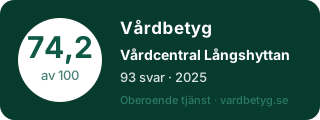 This is how the badge looks.
Watch Vårdcentral Långshyttan
Get an email when we have added new figures for Vårdcentral Långshyttan, at most once a month. The email shows the figures now next to the ones you saw last time. Nothing else, no adverts.
Would you rather follow every health centre in Hedemora? Watch all of Hedemora
How to read the rating
A rating is an average with a margin of error. Two health centres that are close together may be equally good.
How the rating is worked outKnow someone looking for a health centre in Hedemora?
Pass the page on. They get a link and nothing to sign up for.
Frequently asked questions
How good is Vårdcentral Långshyttan?
Vårdcentral Långshyttan has a Vårdbetyg score of 75.8 out of 100, which is a high score. The Vårdbetyg is a combined measure of how patients experience the health centre and how accessible it is, based on the National Patient Survey 2025 and the National Board of Health and Welfare's waiting-time statistics.
How is the Vårdbetyg score calculated?
The Vårdbetyg weights patient experience (the National Patient Survey answers) at 70% and accessibility (waiting times from the National Board of Health and Welfare) at 30%. Before the parts are combined, each is pulled toward its own national average when the basis is small (the method is called Bayesian shrinkage), patient experience by how many people responded and accessibility by how many cases the waiting times are based on. The combined score is not adjusted a second time. A health centre with a thin basis should therefore not be able to top the ranking by chance. The method is open.
How many people responded about Vårdcentral Långshyttan?
The Vårdbetyg for Vårdcentral Långshyttan is based on 93 patients who responded to the National Patient Survey 2025. That corresponds to a response rate of 62%. We always show the number of responses and the margin of error next to the score, so it is clear how solid the basis is.
Source: National Patient Survey 2025 (SKR). Open data at resultat.patientenkat.se.